
Hyderabad has long been seen as a beacon of urban growth, but its current momentum in real estate is unlike anything seen before. Fueled by visionary infrastructure initiatives like the Outer Ring Road (ORR), the Regional Ring Road (RRR), and Hyderabad Metro’s ambitious expansion, the city is no longer growing, it’s transforming. These projects are not just about easing traffic or shortening commutes; they’re redefining where people live, work, and invest. The property market inside the ORR has matured, with prices soaring to levels inaccessible to many middle-income families. As a result, the spotlight has shifted to the outer periphery zones once dismissed as too remote but now central to Hyderabad’s future.
Let’s explore how each of these infrastructure milestones is reshaping the real estate map, boosting property values, and unlocking fresh opportunities across the city.
ORR Expansion: The Catalyst That Changed Everything
The 158-km-long Outer Ring Road has been the backbone of Hyderabad’s recent transformation in Telangana. Connecting major hubs, IT corridors, and the international airport, the ORR did more than reduce congestion, it created new real estate goldmines.
Why ORR expansion matters now:
- Strategic connectivity: ORR links tech hubs like Gachibowli, Financial District, and Shamshabad, improving travel efficiency.
- Investor magnet: Areas such as Kokapet, Narsingi, and Tukkuguda saw price appreciation of 50–100% in the last 3–5 years.
- Commercial boost: Malls, business parks, and logistics hubs flourished along the ORR.
Key implications for homebuyers and developers:
- Developers now prioritize ORR-adjacent plots for gated communities and villa projects.
- Middle-class buyers are squeezed out of core ORR zones and are moving towards emerging sectors.
The ORR has become a reference point. If you’re within it, you’re in a prime zone. Outside it? You’re in the next growth corridor.
Regional Ring Road (RRR): Hyderabad’s Next Big Leap
If ORR redefined the city, the proposed 340-km RRR promises to reimagine the region. By connecting districts like Yadadri-Bhuvanagiri, Sangareddy, and Vikarabad, the RRR is poised to unlock rural and semi-urban belts for urban development.
Here’s what makes the RRR a game-changer:
- Decentralization: It encourages residential and industrial growth away from city congestion.
- Affordability reset: Land outside the RRR is currently 30–50% cheaper than ORR-adjacent zones.
- Balanced development: Infrastructure parity between north, south, and west Hyderabad.
Emerging real estate pockets around the RRR:
- Chevella & Shadnagar: Fast-growing for villa and plotting projects.
- Bibinagar: Close to AIIMS and Yadadri temple ideal for both end-users and investors.
- Kandi: A hotbed for HMDA layouts and upcoming townships.
RRR is still on the drawing board, but smart investors are already placing their bets.
Airport Proximity and Its Ripple Effect on Property Demand:
The Rajiv Gandhi International Airport in Shamshabad has grown from being a transit hub to a central pillar of Hyderabad’s real estate narrative. With increasing global business travel, tourism, and cargo movement, areas within a 15–20 km radius of the airport are witnessing an unexpected property boom. This isn’t just about being close to the runway connectivity through the ORR and the proposed Metro extension has turned this southern stretch into a magnet for both residential and commercial investments.
Localities like Tukkuguda, Adibatla, and Raviryala, once sleepy outskirts, are now pulsing with activity. Developers are launching gated communities and high-rise towers here, not only to attract IT professionals working in the Aerospace and SEZ corridors but also NRIs looking for investment-ready locations. The strategic placement of logistics parks and data centers near the airport is further fueling the demand for both rental and purchase properties.
This ripple effect is powerful. As the airport expands and transit times drop with new infrastructure, the land value in its vicinity is set to rise significantly. It’s not just about catching flights, it’s about catching the wave of transformation before it fully arrives.
Hyderabad Metro Expansion: A Game Changer for Accessibility
Phase 2 of the Hyderabad Metro is a ₹43,000 crore leap that will bring transit solutions to the city’s outskirts. With routes planned from Nagole to Shamshabad Airport and Miyapur to Patancheru, the expansion integrates outer zones into the city’s heartbeat.
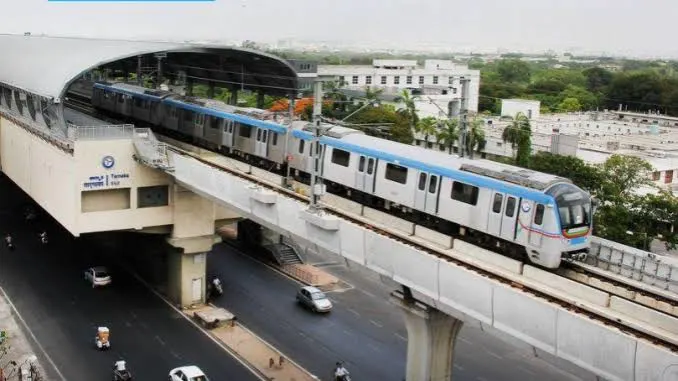
The upcoming routes will:
- Connect Hyderabad Airport to the core city in under 45 minutes.
- Provide metro access to real estate hotspots like Patancheru, LB Nagar, and Hayathnagar.
- Encourage vertical development in areas where land is still available.
Why Metro drives real estate premiums:
- Properties within 500 meters of metro stations see 15–25% higher demand.
- Rental yields increase due to reduced commuting times.
Metro Phase 2 is not just a transport project; it’s a lifestyle enabler that will attract new homebuyers to the periphery.
The New Reality: Inside ORR vs. Beyond ORR
As property rates soar within the ORR, a visible shift is taking place. Builders are pivoting their attention outward, offering premium amenities at more affordable rates.
Current trends reflect this divergence clearly:
- Inside ORR: High-density apartments, luxury towers, and price saturation.
- Outside ORR: Villas, gated plots, and large-scale integrated townships.
Why buyers are moving beyond ORR:
- Affordability: Properties cost 30–40% less beyond ORR.
- Space: Bigger homes, private gardens, and better quality of life.
- Connectivity: Improved roads and future-ready projects like RRR and Metro.
The real estate map is expanding, and the future belongs to those who look beyond traditional boundaries.
Challenges Ahead: Regulation, Infrastructure Lag & Sustainability
Despite the booming numbers, Hyderabad’s real estate growth is not without roadblocks. The surge in demand must be matched with thoughtful planning and transparent governance.
Ongoing and potential challenges include:
- Approval delays: Older HMDA layouts are in demand, but require careful legal verification.
- Infrastructure readiness: Some RRR zones lack proper sewage, water, and power infrastructure.
- Speculation risk: Overpriced ventures in underdeveloped areas can mislead first-time buyers.
Steps being taken:
- TS-bPASS (Telangana State Building Permission Approval and Self-Certification System) streamlines approvals.
- Focus on smart layouts and utility provisioning in Phase II zones.
- Sustainable real estate codes being pushed for green buildings.
Growth is inevitable, but Hyderabad must ensure that growth is responsible and inclusive.
Plot Investments Surge: The Return of Land as a Wealth Builder
While apartments have dominated the last decade, 2025 marks a turning point where plot investments are back in vogue especially in and around the ORR and future RRR corridors. People are once again betting big on open land, not just for long-term wealth creation, but to build custom villas, farmhouses, or even small-scale co-living units as infrastructure matures.
The demand is particularly strong among young professionals and second-time investors who are priced out of central city properties. With options in Shadnagar, Kothur, Kandukur, and Chevella offering plotted developments at reasonable rates with HMDA or DTCP approvals , the shift is clear and land is no longer a slow game. Add upcoming metro lines, improved roads, and promise of rapid appreciation, and plot investment becomes both a lifestyle and financial decision.
Interestingly, many buyers are forming cooperative buying groups to secure larger parcels at lower per-square-yard rates. For those thinking long-term say 5–8 years the potential to multiply their investment is far more tangible than traditional apartment appreciation.
Conclusion:
Hyderabad is witnessing a rare convergence of infrastructure development and real estate opportunity. The ORR opens the door, the RRR widens the corridor, and the Metro will seamlessly connect it all. What we’re seeing is not just property appreciation, it’s a city being reimagined.
For homebuyers, the message is clear: waiting too long could mean being priced out. For investors, now is the moment to spot undervalued zones before the next wave hits. Hyderabad’s growth story is still unfolding, and if the current momentum continues, the city may well become a blueprint for future-ready urban living across India.
FAQs:
Due to ORR and upcoming Metro and RRR projects, demand for well-connected land has surged. Add IT jobs, quality infrastructure, and proactive governance, and it’s a perfect storm for real estate inflation.
Yes, areas beyond the ORR offer better affordability, future connectivity via RRR and Metro, and large-scale plotted and villa developments.
The ₹43,000 crore expansion is expected to be completed in phases over the next 5–10 years, with key corridors prioritized for early execution.
The Regional Ring Road (RRR) is a 340 km outer corridor aimed at connecting district towns. It will decentralize development and open up new residential and commercial hubs.
Buyers must verify approvals (like HMDA or DTCP), ensure basic amenities exist or are planned, and be wary of speculative pricing in underdeveloped zones.