
Hyderabad’s rapid urban expansion has placed immense pressure on its existing transport infrastructure, particularly along the Outer Ring Road (ORR). To address rising congestion and create a seamless connection to key upcoming projects, the Hyderabad Metropolitan Development Authority (HMDA) has proposed a new interchange on ORR. This interchange, to be integrated with the Budvel interchange currently under construction, is designed to improve connectivity to the much-anticipated Musi Riverfront and other fast-developing regions like the Budvel layout.
More than just a road project, it’s a crucial urban mobility upgrade aimed at enhancing accessibility, reducing travel times, and supporting economic growth in western Hyderabad.
Strategic Importance of the New Interchange:
The proposed interchange sits at a critical junction of the ORR’s 143rd kilometre, where the radial road from the western side will merge with the highway. This location is no accident; it’s a deliberate choice to serve two rapidly developing hubs: Budvel layout and the Musi Riverfront.

- Direct connectivity: The design will enable smooth travel from the radial road towards Shamshabad and Gachibowli without routing through congested entry points.
- Traffic relief: Current entry and exit points near Rajendranagar often experience bottlenecks, and this interchange is expected to ease that load.
- Urban integration: By connecting new residential, commercial, and recreational zones directly to ORR, it aligns with Hyderabad’s master plan for balanced urban growth.
This integration ensures that the interchange isn’t merely a transport facility but a key enabler of Hyderabad’s next growth phase.
Design Features and Integration with Budvel Interchange:
The Budvel interchange, under construction, already includes elevated ramps to serve the Budvel layout in Hyderabad, Telangana. The new interchange will extend this network, allowing:
- Bidirectional connectivity: Traffic from the radial road can move towards both Shamshabad and Gachibowli, and vice versa.
- Seamless merging: Engineering will ensure minimal conflict points where the new ramps connect to existing lanes.
- Future-proofing: The design will account for projected increases in vehicle volume over the next decade.
This coordinated approach between the two interchanges means better traffic distribution and reduced strain on existing routes, making commutes smoother for residents and visitors alike.
Potential for Integrated Public Transport Links:
The new interchange also opens up opportunities to rethink public transport integration in the ORR corridor. With the Musi Riverfront expected to draw large crowds, feeder bus services, electric shuttle connections, and dedicated pick-up/drop-off bays could be incorporated into the interchange design. This would allow visitors to leave their private vehicles behind and rely on shared transport options, reducing traffic volume and emissions.
Coordination with MMTS, Metro extensions, or future regional rail lines could make the interchange a multi-modal hub, connecting road, rail, and riverfront activities seamlessly. By building these provisions into the project from the start, the interchange could evolve into more than just a highway connector; it could serve as a vital node in Hyderabad’s expanding public transport ecosystem.
Addressing Congestion and Safety Concerns:
Over the years, rapid development around ORR has created unforeseen traffic challenges. The initial designs with vehicular underpasses are now insufficient for the growing demand. This new interchange aims to:
- Divert heavy traffic away from overstressed exits like Rajendranagar.
- Reduce accident-prone congestion zones.
- Improve lane discipline by introducing clearer signage and better entry/exit geometry.
Key Benefits:
- Lower average travel time by up to 20%.
- Reduced risk of rear-end collisions is common in congested exit zones.
- Safer merging points with well-marked lanes.
By pairing infrastructure upgrades with safety-focused engineering, the project prioritizes both speed and security.
Boost to Musi Riverfront Development:
The Musi Riverfront is set to become one of Hyderabad’s most significant urban transformation projects, blending recreation, tourism, and environmental restoration. This interchange will:
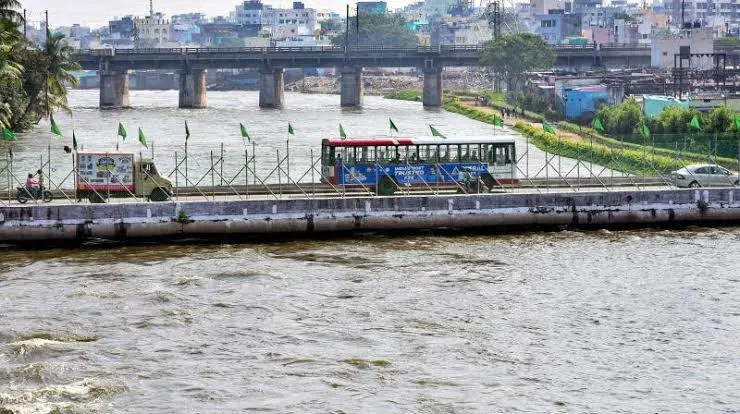
- Provide direct access for visitors from ORR, encouraging weekend tourism.
- Support economic activity with easier logistics for businesses in the riverfront precinct.
- Reduce local traffic chaos by diverting visitors straight from the highway.
In short, the interchange becomes the gateway that ensures the Musi Riverfront doesn’t just look good on paper but is accessible and vibrant from day one.
Economic and Social Impact:
Beyond its immediate utility, the interchange is expected to drive:
- Real estate growth: Properties near the interchange are likely to appreciate as connectivity improves.
- Job creation: Both during construction and post-completion through businesses attracted to the improved accessibility.
- Community benefits: Easier commutes mean more time for residents to engage in social and recreational activities.
Like many major infrastructure projects, its ripple effects will be felt in housing, retail, hospitality, and even educational sectors nearby.
Environmental Considerations in the Interchange Design:
While the new ORR interchange is a major step towards improved connectivity, it also needs to blend with Hyderabad’s environmental sustainability goals. The area near the Musi Riverfront has ecological significance, and construction must avoid disturbing its natural flow and biodiversity. HMDA is expected to incorporate green engineering solutions, such as landscaped medians, noise barriers with vegetation, and proper stormwater drainage systems to prevent flooding during heavy rains.
The design will also prioritize minimal tree cutting by adjusting ramp alignments and using retaining walls where possible. Given the increased focus on eco-friendly urban infrastructure, the interchange could become a model for balancing mobility needs with environmental responsibility, ensuring that development does not compromise the region’s natural charm.
Timeline and Project Execution:
The HMDA has already initiated the process by inviting bids for a Detailed Project Report (DPR).
Planned Schedule:
- DPR Submission: Within three months of commencement.
- Design Finalization: Following feasibility studies and traffic modelling.
- Construction Start: After securing approvals and funding.
Close coordination between contractors, traffic police, and urban planners will be essential to minimize disruption during construction.
Conclusion:
The new ORR interchange isn’t just another road addition, it’s a strategic piece of urban planning designed to knit together Hyderabad’s present needs with its future vision. By directly linking the Budvel layout, Musi Riverfront, and other emerging zones to ORR, it promises faster commutes, safer travel, and stronger economic growth. As the city evolves, projects like these will determine how smoothly Hyderabad transitions into its next era of expansion.
FAQs:
It will connect the radial road on the western side to the ORR at the 143rd kilometre, integrating with the Budvel interchange.
It will offer direct ORR access to the riverfront, reducing local congestion and making the area more accessible for tourism.
Yes, by providing an alternative entry/exit, it will ease pressure on Rajendranagar’s congested points.
The DPR is expected within three months of commencement, after which construction timelines will be set.
Yes, the design will factor in projected traffic volumes for the next decade to ensure long-term efficiency.